
Today is Learn (or Discover) What Your Name Means Day (March 4) (National Today 2026).
A name can be deeply personal, based on our family histories, language, faith and memories. But it’s also something researchers can read as a signal.
Names are metadata: mini datasets that signal time, place, and culture.
Public datasets and public reporting make it possible to see naming shifts over time: what names come to symbolise, how preferences move, how spellings change, and how cultural moments leave fingerprints on what parents choose. England & Wales, for example, has historical baby-name rankings published going back to 1904 (ONS 2016).
Jamaica in the 2000s: continuity, trend, and spelling
A republished Registrar General’s Department (RGD) list for 2008 included girls’ names like Brihanna and Rhianna, and boys’ names like Daniel (Nancy’s Baby Names 2011).
That’s a useful snapshot because it shows two dynamics at once:
- Continuity through faith and familiarity. Names like Daniel persist partly because they’re tied to widely known (and liked) biblical stories and figures, and they travel well across families, communities, and generations. The same logic helps explain why names like David (linked to one of the most celebrated biblical figures) recur across many predominantly Christian contexts: they come with shared reference points, and their meaning is widely understood.
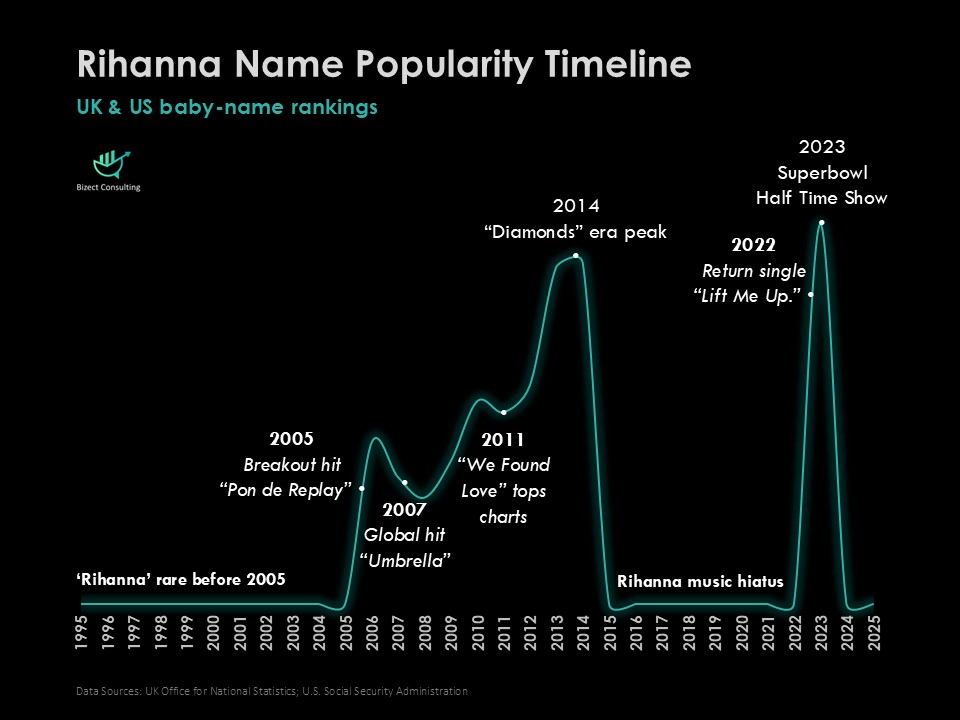
- Trend and spelling variation. Names like Brihanna and Rhianna show how sound patterns and spellings evolve (which matters when you’re counting; variants can hide the true size of a trend, and grouping variants can change what appears “most popular”). The spelling “Rihanna” itself was extremely rare before the mid-2000s, even though related forms such as Rhianna and Rhiannon existed earlier. Those earlier names trace back to Rhiannon, a figure from Welsh mythology. In England & Wales name rankings, the spelling “Rihanna” first appears in 2005 and climbs rapidly in the following years—timing that aligns closely with Rihanna’s global musical breakout in the mid-2000s. This makes it a clear example of how an existing name can gain new visibility, and a new spelling, through cultural influence.
A later Jamaica Observer report, based on RGD preliminary reporting for 2017 registrations, lists Jayden as the top boy name and Amelia as the top girl name. It also notes that Jayden had been #1 for boys since 2010, after overtaking Daniel (Jamaica Observer 2018).
The same reporting also points to pop-culture influence in a way that’s unusually direct: it states that from 2005, “Rihanna” and “Brianna” alternated as top picks for girls until Gabrielle took over in 2010 (Jamaica Observer 2018). This is a helpful reminder that cultural visibility can show up in naming choices, and it can show up across spellings, too.
Part of what we’re seeing in those shifts is the interaction between older naming traditions and newer global trends. Jayden, which rose to the top of Jamaican boys’ names in the 2010s, fits into a broader international wave of -ayden / -aiden names (Aiden, Brayden, Hayden) that became popular across English-speaking countries in the late 1990s and 2000s. Names in this sound family often spread quickly once one variant becomes familiar. Gabrielle, which appears among leading girls’ names in earlier Jamaican lists, represents a different pattern: it is the French feminine form of Gabriel, derived from the Hebrew Gavri’el (“God is my strength”), and its biblical association with the archangel Gabriel gives it enduring appeal in Christian contexts.
Keisha and the “-eisha / -isha” sound family
Some naming trends show up not just as one name rising, but as a naming style spreading.
In U.S. name popularity tracking, Keisha is especially prominent from the late 1970s through the 1980s (Behind the Name n.d.-a). Behind the Name notes that it began to be used in the 1960s and may be invented or related to Keziah (Behind the Name n.d.-b).
This connects to a broader naming pattern that scholars of naming and language have described in African American communities: the creation of “new” names by combining fashionable prefixes and suffixes, including endings such as -isha. A classic discussion describes “Lakeisha”-type forms built from prefixes (like La-, Sha-, De-, Ka-, Na-) paired with suffixes including -isha (Black 1996). That framework helps explain why names ending in -eisha / -isha became recognizable as a sound family across Black diaspora contexts from the late 20th century onward.
When culture changes the meaning of a name (for better or worse)
This isn’t a modern phenomenon. The record is full of examples where public figures and stories reshape naming.
- Shirley (1849): “Shirley” was historically a surname/place name and had male usage in some contexts, but it became established as a female given name after Charlotte Brontë’s novel Shirley (1849). The novel’s popularity is widely credited with helping shift the name’s gender association (Wikipedia contributors 2026a).
- Rihanna (2000s): In England & Wales, the given name “Rihanna” jumps sharply in rank in the mid-2000s—visible in name popularity tracking for the region (Behind the Name n.d.-c). In Jamaica, RGD-linked reporting explicitly mentions “Rihanna” among top choices in the mid-2000s (Jamaica Observer 2018).
- Khaleesi (2010s): The U.S. Social Security Administration lists Khaleesi among names that increased in popularity (one way the SSA surfaces notable movers) (SSA n.d.).
- Adolf (post-WWII): “Adolf” is a well-known negative example: sources note a major decline in usage after World War II due to its association with Adolf Hitler (Wikipedia contributors 2026b).
Names tell stories. They also leave a trail you can measure—of history, influence, migration, faith, media, and the small ways culture becomes personal.
Do you know your name meaning?
References
- Behind the Name. n.d.-a. “Popularity for the Name Keisha (United States).” Accessed March 4, 2026. https://www.behindthename.com/name/keisha/top/united-states
- Behind the Name. n.d.-b. “Meaning, Origin and History of the Name Keisha.” Accessed March 4, 2026. https://www.behindthename.com/name/keisha
- Behind the Name. n.d.-c. “Popularity for the Name Rihanna (England & Wales).” Accessed March 4, 2026. https://www.behindthename.com/name/rihanna/top/england-wales
- Black, Kerrigan. 1996. “Afro-American Naming Traditions.” Names 44 (2): 105–125. (Accessed via ResearchGate, March 4, 2026.) https://www.researchgate.net/publication/270557664_Afro-American_Personal_Naming_Traditions
- Jamaica Observer. 2018. “What Are Jamaican Parents Naming Their Babies? Arianna, Jayden Top Picks for 2017.” All Woman, December 11, 2018. https://www.jamaicaobserver.com/allwoman/2018/12/11/what-are-jamaican-parents-naming-their-babies/
- National Today. 2026. “Learn What Your Name Means Day — March 4, 2026.” Accessed March 4, 2026. https://nationaltoday.com/learn-what-your-name-means-day/
- Nancy’s Baby Names. 2011. “Popular Baby Names in Jamaica, 2008.” December 23, 2011. https://www.nancy.cc/2011/12/23/popular-baby-names-jamaica-2008/
- Office for National Statistics (ONS). 2016. “Baby Names Since 1904: How Has Yours Performed?” September 2, 2016. https://www.ons.gov.uk/peoplepopulationandcommunity/birthsdeathsandmarriages/livebirths/articles/babynamessince1904howhasyoursperformed/2016-09-02
- Social Security Administration (SSA). n.d. “Popularity Increase: Names That Increased the Most in Popularity from the Previous Year.” Accessed March 4, 2026. https://www.ssa.gov/oact/babynames/popularity_increase.html
- Wikipedia contributors. 2026a. “Shirley (novel).” Wikipedia, The Free Encyclopedia. Accessed March 4, 2026. https://en.wikipedia.org/wiki/Shirley_(novel)
- Wikipedia contributors. 2026b. “Adolf.” Wikipedia, The Free Encyclopedia. Accessed March 4, 2026. https://en.wikipedia.org/wiki/Adolf
First published on LinkedIn in March 2026.


