
I have been thinking a lot about water lately, mostly because I haven’t had any at home for more than two weeks.
Living off the Red Hills area, water lock-offs are not new to me, but this current period has been particularly difficult. Our tanks are now empty and, on the occasions when the NWC supply returns, the pressure is often insufficient to replenish them.
It changes the calculus of everyday life in ways that are difficult to appreciate until you experience it for an extended period. Cooking, bathing, laundry, cleaning and virtually all other household activity requires some consideration of how much water is available, how much can be spared, and when it might return.
The experience prompted me to revisit a research exercise I conducted for two clients in 2019 on chronic domestic water shortages and the potential for household water conservation.
Seven years later, I was struck by how familiar many of the underlying issues remain.
At the time, I examined Jamaica’s water problem through the lens of economic rather than purely physical water scarcity. Jamaica has considerable freshwater resources, but water availability at the national level does not automatically translate into reliable supply at the household level. Geography matters. So do storage and treatment capacity, the condition of the distribution network, where population and economic activity are concentrated, land and watershed management, and our ability to move water from areas of relative abundance to areas of high demand.
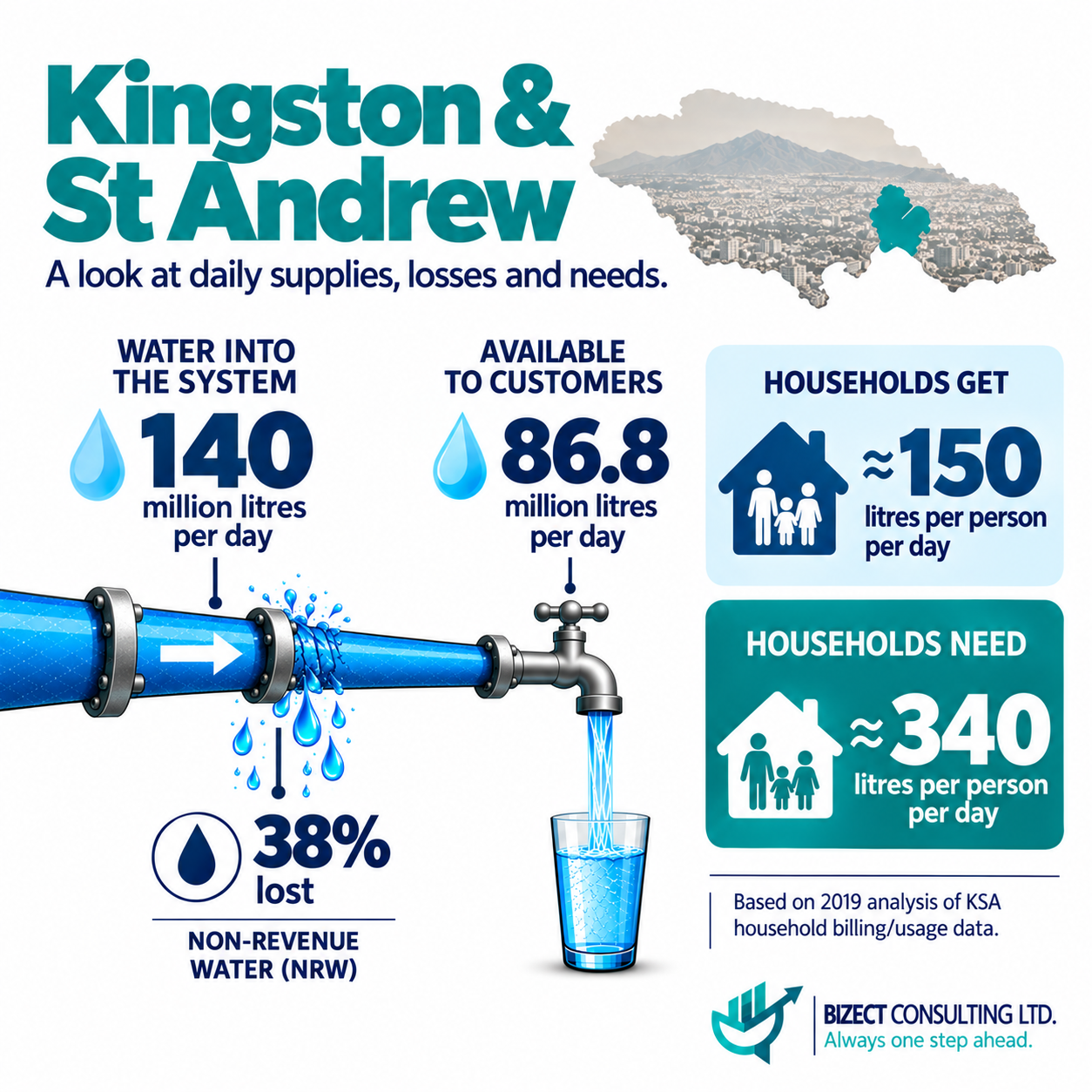
The 2019 research identified several longstanding pressures: ageing infrastructure, high levels of non-revenue water, siltation reducing effective reservoir capacity, increasing urban demand, and changes in the timing and distribution of rainfall. At the time, more than 60% of the island’s water infrastructure had been reported as too old to be effective, while more than half of the water produced for Kingston was reportedly being lost through leaking pipes or illegal connections.
Climate was already an important part of that analysis. Reservoirs and water-supply systems designed using historical hydrological records are operating under increasingly different conditions. The report questioned the adequacy of infrastructure designed for an earlier rainfall regime and a much smaller and less densely developed urban population.
The scale of that change is worth noting. Hermitage Dam opened in 1927, when the combined population of Kingston and St Andrew was just under 120,000. Mona Reservoir came fully into service in 1959, when the population was approximately 420,000. Today, the combined KSA population is estimated at around 700,000. These systems are serving a very different city from the one they were designed for.
That is not to say that significant water infrastructure has not been added or upgraded since Independence. The Yallahs Pipeline (1983–86) was followed by major rehabilitation and modernisation programmes, including IDB-supported investments in the 2000s and 2010s and the J$5 billion KSA Non-Revenue Water programme from 2015–2020. These interventions upgraded treatment facilities, pipelines, monitoring and pressure-management systems and reduced water losses.
In fact, Government now reports that non-revenue water in the Corporate Area has fallen from about 71% in 2016 to approximately 38% today, which is substantial progress. But the Corporate Area’s two principal storage facilities remain remarkably old relative to the population, density and climatic conditions they are now expected to support, and major new transmission and production works are still being pursued.
All of this feels particularly relevant in 2026.
Jamaica is experiencing a genuine drought, and reduced inflows into water-supply systems are clearly an immediate cause of the current restrictions. But drought is acting on a water system with pre-existing vulnerabilities. Rainfall, infrastructure, storage, distribution losses, population and development patterns, watershed condition and household demand are interacting parts of the same problem.
There is also the matter of the role of the consumer.
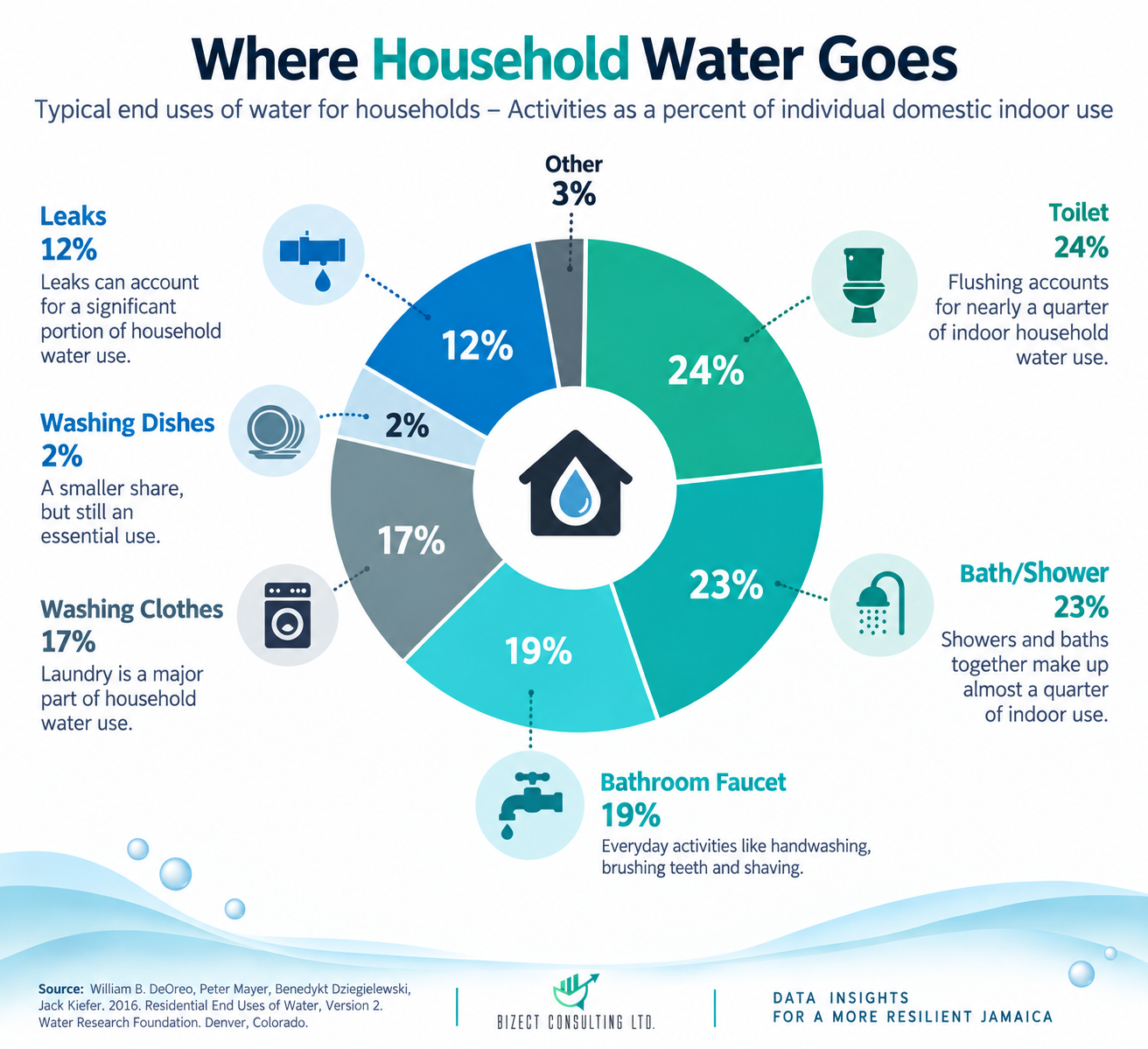
My research modelled the potential impact of low-flow fixtures, efficient toilets, faucet aerators and household leak reduction. The analysis suggested substantial scope for reducing domestic demand. The broader conclusion, however, was not that households could conserve their way out of Jamaica’s water problems. Conservation could only be one component of a much larger response that also required improvements in storage, distribution infrastructure and water and land management.
That distinction matters even more to me now.
I can ration the water in my tank. I can change how I wash dishes, do laundry or bathe. I can install more efficient fixtures. But none of those things addresses a distribution system that cannot deliver sufficient water pressure to refill the tank in the first place.
There are significant investments now underway, including further efforts to reduce non-revenue water and plans to improve the interconnection of water systems across the island. Those are important developments.
But revisiting this research seven years later leaves me with a broader question:
How much of what we are experiencing today is an exceptional drought event, and how much is the predictable consequence of known structural vulnerabilities that we have not addressed quickly enough?
For me, that is where the data become important.
Not simply how much rain fell, or how full a reservoir is today, but how rainfall, abstraction, storage, treatment, distribution losses, demand, population growth and infrastructure investment have changed over time — and whether the trajectory of our response is keeping pace with the trajectory of the risk.
Because in 2019 we already knew many of the pressures we were facing.
The useful question in 2026 is what we have done about them.


